
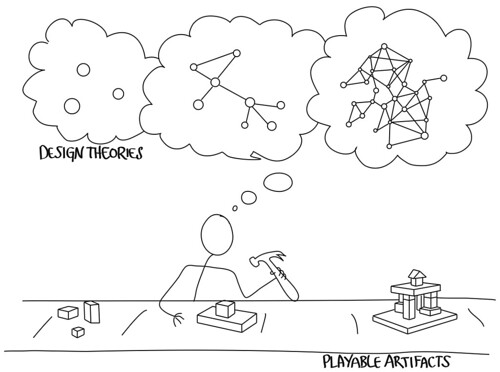
In my recent PhD thesis proposal I described how I am going to tackle game design as a new domain for automated discovery. A key piece of this is figuring out game design might be explained as the kind of knowledge-seeking effort you might expect from science or mathematics. With successful systems performing discovery (such as Simon Colton’s HR system which contributed some new and interesting knowledge in pure mathematics) and new projects beginning to automate the process of exploring a space of games (such as Julian Togelius’ Automatic Game Design experiment), the idea of mashing these together into a “game design discovery system” seems quite attractive to me.
But hold on a second, game designers don’t often think of themselves as scientists or mathematicians any more often than painters or musician do. What’s going on here?


 This summer, I’m working with Matt MacLaurin at Microsoft Research on Kodu Game Lab. For those of you who aren’t familiar, Kodu is an environment for people with no programming experience to quickly create games. Its visual programming language is designed to be intuitively understandable and its library of characters and objects facilitate rapid game development. If you’re interested in checking it out yourself, it’s currently available for the very reasonable price of $5 through X-Box Live Arcade.